| Chester
Football Club was founded in 1885 as an amalgamation
of Chester Rovers and Old King’s Scholars and
initially played their home games at Faulkner Street
in the Hoole area of the city. For the first five years
of their existence they only played friendlies until
joining the Combination League in 1890. A first senior
trophy, the Cheshire Senior Cup, was won in 1895 and
in 1898 the club relocated to the Old Showground also
in Hoole. The stay was only brief as, twelve months
later, the club were forced to temporarily disband when
the ground was lost to housing.
 In 1901 a new home was found in Whipcord Lane and the
club went from strength to strength, winning the Combination
League in 1909 after finishing runners-up in the preceding
five seasons. The early 1900s saw the first of Chester’s
Welsh Cup victories, against Connah’s Quay in
1908, and further victories followed in 1933 and 1946.
By now the club had moved to the much loved Stadium,
in Sealand Road, which remained home for 84 years until
the final game against Rotherham United in April 1990.
In 1901 a new home was found in Whipcord Lane and the
club went from strength to strength, winning the Combination
League in 1909 after finishing runners-up in the preceding
five seasons. The early 1900s saw the first of Chester’s
Welsh Cup victories, against Connah’s Quay in
1908, and further victories followed in 1933 and 1946.
By now the club had moved to the much loved Stadium,
in Sealand Road, which remained home for 84 years until
the final game against Rotherham United in April 1990.
In 1910 Chester was elected to the Lancashire Combination
and after the First World War were founder members of
the Cheshire County League which they won in 1922, 1926
and 1927. The appointment of Charlie Hewitt as manager
in 1930 saw a concerted effort to attain League status
and crowds flocked to the Stadium to see the goalscoring
exploits of Salford school master Arthur Gale who scored
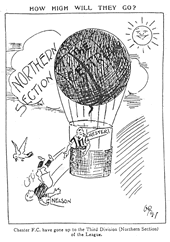
an incredible 73 goals in 39 League games. On June 1st
1931 Chester were elected to the Football League, in
place of Nelson, and throughout the 1930s never finished
outside the top 10 in Division Three North. In 1933
Chester hammered Second Division Fulham 5-0, their finest
FA Cup performance, and in 1936 the club achieved their
highest League victory, a 12-0 win over York City.
 Chester struggled in the years following the Second
World War but was well served by stalwarts Ray Gill
(a record 406 appearances), Ron Hughes, Eric Lee and
Tommy Astbury. In 1964/65 the ”Famous Five“
forward line of Talbot, Metcalf, Ryden, Morris and Humes
scored 116 of Chester’s record 119 League goals
while, in the FA Cup, the club were narrowly beaten
2-1 by League champions Manchester United after leading
at half time.
Chester struggled in the years following the Second
World War but was well served by stalwarts Ray Gill
(a record 406 appearances), Ron Hughes, Eric Lee and
Tommy Astbury. In 1964/65 the ”Famous Five“
forward line of Talbot, Metcalf, Ryden, Morris and Humes
scored 116 of Chester’s record 119 League goals
while, in the FA Cup, the club were narrowly beaten
2-1 by League champions Manchester United after leading
at half time.
Promotion from Division Four was achieved under Ken
Roberts in 1974/75. The club also reached the League
Cup Semi-Final where they were narrowly defeated by
Aston Villa following wins over League champions Leeds
United (the 3-0 victory is arguably the club’s
greatest result) and Newcastle United. The late 1970s
saw the emergence of Ian Rush, who became the club’s
record transfer when he moved to Liverpool for £300,000.
Relegation in 1982 was followed by a name change, to
Chester City, in 1983 and three years later Harry McNally
led the club back into Division Three.
 The
sale of the Sealand Road ground in 1990 saw Chester
forced to play their home games at Macclesfield for
two years. Unfortunately a return to the city, and the
6,000 capacity Deva Stadium, culminated in relegation
although there was one bright spot when Stuart Rimmer
broke Gary Talbot’s league scoring record. The
popular striker went on to score a total of 135 League
goals for Chester. The
sale of the Sealand Road ground in 1990 saw Chester
forced to play their home games at Macclesfield for
two years. Unfortunately a return to the city, and the
6,000 capacity Deva Stadium, culminated in relegation
although there was one bright spot when Stuart Rimmer
broke Gary Talbot’s league scoring record. The
popular striker went on to score a total of 135 League
goals for Chester.
In 1994 Graham Barrow led City back to Division Two
but the yo-yo existence continued with relegation in
1995. Former Everton and Wales captain, Kevin Ratcliffe,
led the club to the play-offs in 1997 and was also in
charge during the traumatic 1998/99 season when the
club went into administration and almost folded due
to financial problems. In July 1999 controversial American,
Terry Smith, purchased the club and quickly installed
himself as manager. However, Chester struggled at the
foot of the table and despite the belated appointment
of Ian Atkins the club were relegated to the Conference,
after 69 years in the Football League, following a heartbreaking
home defeat to Peterborough United on the final day
of the season.
 By
the 2001/02 season Chester were facing a further relegation
down to the Unibond League but Smith sold the club to
Liverpool businessman Stephen Vaughan in October 2001
and results started to improve on the field following
the appointment of Mark Wright as manager at the start
of 2002. By
the 2001/02 season Chester were facing a further relegation
down to the Unibond League but Smith sold the club to
Liverpool businessman Stephen Vaughan in October 2001
and results started to improve on the field following
the appointment of Mark Wright as manager at the start
of 2002.
The revival continued into the 2002/03 season when a
host of new signings took Chester to the Conference
play-offs. Two hard fought games against Doncaster Rovers,
in the semi-final, saw Chester defeated on penalties
but the club bounced back strongly from this setback.
Based around a strong defence, and the 49 goal partnership
of Daryl Clare and Darryn Stamp, City took the Conference
by storm in 2003/04 and with only four defeats in 42
games deservedly secured a place back in the Football
League. Promotion was guaranteed with a 1-0 victory
over Scarborough in front of a delirious capacity crowd
at the Deva Stadium who celebrated Chester’s first
championship in 77 years.
Unfortunately, the next four seasons back in the Football
League, saw a succession of managers and a series of
struggles against relegation. City started the 2008/09
with Simon Davies in charge but the former youth team
coach was replaced by Mark Wright in November for his
third spell as manager. Sadly, the departure of many
experienced players during the transfer window saw City
relying on youth team players for the remainder of the
campaign and the club were relegated back to the Football
Conference. Their final Football League game, on May
2nd 2009, resulted in a 2-1 home defeat to Darlington.
During that summer Chester was placed into administration
by Stephen Vaughan and given an automatic ten point
deduction by the Football Conference. In a controversial
move, the Vaughan family bought back the club and transferred
the ownership to a new company, Chester City 2004 Ltd.
However the CVA agreed with the creditors was thrown
out by HMRC resulting in a further fifteen point deduction
as the FA refused to accept the new club’s affiliation.
Unfortunately the financial problems that had dogged
the club prior to administration quickly returned. On
the field, manager Mick Wadsworth was replaced by the
experienced Jim Harvey in October. Although there was
a brief upturn in results the appointment of Morrell
Maison as Director of Football heralded the departure
of Harvey at the end of the year.
Chester started 2010 with a team of untried youngsters
as more players departed the club. On February 6th the
club played their last ever game, a 2-1 home defeat
to Ebbsfleet United. Three days later the club were
unable to field a team to play at Forest Green Rovers
and the next home fixture, against Wrexham, was called
off when the council served a prohibition notice over
unpaid police bills.
On February 11th Chester was suspended by the Football
Conference and two weeks later expelled from the league.
The club was finally wound up in the High Court on March
10th 2010 in the year of their 125th anniversary.
 While
the old club was falling apart the supporters group,
City Fans United, was already beginning to prepare for
the worst and when Chester City was wound up the fans
were in an a strong position to launch a phoenix club.
At the start of May the lease to the Deva Stadium was
secured by the supporters group and Chester Football
Club was officially reborn on Thursday May 20th 2010. While
the old club was falling apart the supporters group,
City Fans United, was already beginning to prepare for
the worst and when Chester City was wound up the fans
were in an a strong position to launch a phoenix club.
At the start of May the lease to the Deva Stadium was
secured by the supporters group and Chester Football
Club was officially reborn on Thursday May 20th 2010.
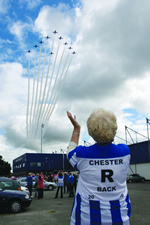 Neil
Young was unveiled as the manager of the reformed Chester
and along with assistant Gary Jones set about assembling
a squad from scratch for the new supporter’s owned
club. Young arrived from Colwyn Bay having experienced
two successful seasons with the Welshmen. Neil
Young was unveiled as the manager of the reformed Chester
and along with assistant Gary Jones set about assembling
a squad from scratch for the new supporter’s owned
club. Young arrived from Colwyn Bay having experienced
two successful seasons with the Welshmen.
Chester FC was placed in Evo-Stik League Division 1
North (step four of the National League System) and
played their first ever game, a friendly fixture at
Colwyn Bay, on July 10th 2010. On August 24th the Blues
took to the field for their first competitive game which
resulted in a 1-1 draw at Warrington Town with Rob Hopley
having the distinction of scoring the club’s first
goal.
Two weeks later Trafford were the visitors for the first
match at the newly sponsored Exacta Stadium and 2,734
supporters were treated to a goal feast as the new look
team won 6-0. Michael Wilde netted a hat-trick and he
went on to score 36 league goals that season, including
five trebles, in a total of 107.
 Chester won the league title at Garforth Town on a dramatic
final day. As the Blues were losing 2-1 in Yorkshire,
nearest challengers Skelmersdale United were beating
Ossett Albion 7-2 meaning that Neil Young’s team
secured the champions by the narrow margin of two goals.
Chester won the league title at Garforth Town on a dramatic
final day. As the Blues were losing 2-1 in Yorkshire,
nearest challengers Skelmersdale United were beating
Ossett Albion 7-2 meaning that Neil Young’s team
secured the champions by the narrow margin of two goals.
It was local-born captain George Horan who lifted the
trophy that day and the following year he was lifting
championship silverware for a second time when Chester
won the Evo-Stik Premier League at the first time of
asking. The title was wrapped up, against closest rivals
Northwich Victoria, at the Exacta Stadium on Easter
Monday. In front of 5009 supporters the close neighbours
fought out a 1-1 draw with Matt McGinn scoring a crucial
equaliser five minutes from time. In the end the Blues
finished 17 points clear of Northwich having totalled
100 points and scored 102 goals.
 The
success story continued in 2012/13 when a third title
was celebrated as the Blues ran away with the Blue Square
North by a margin of 16 points over Guiseley. Records
continued to fall as Chester netted more than 100 goals
for the third consecutive season and a record breaking
107 points were accumulated. Another thrilling campaign
was capped off when the Cheshire Senior Cup returned
to the city for the first time since 1932 following
a 2-1 victory over Stalybridge Celtic at Witton Albion. The
success story continued in 2012/13 when a third title
was celebrated as the Blues ran away with the Blue Square
North by a margin of 16 points over Guiseley. Records
continued to fall as Chester netted more than 100 goals
for the third consecutive season and a record breaking
107 points were accumulated. Another thrilling campaign
was capped off when the Cheshire Senior Cup returned
to the city for the first time since 1932 following
a 2-1 victory over Stalybridge Celtic at Witton Albion.
The next five seasons saw the Blues struggle at level
5 with a highest final position of 12th reached in 2014/15.
Relegation to the National League North followed in
2017/18 and, for the first time, joint managers were
appointed in the form of Anthony Johnson and Bernard
Morley. A ninth place finish in their first campaign
in charge was followed by an appearance in the play-offs
during the first Covid curtailed season where Chester
were beaten by Altrincham. The 2020/21 saw another strong
campaign with the Blues placed third when the pandemic
forced the season to end in January.
An indifferent start to the 2021/22 campaign saw Johnson
and Morley replaced by Steve Watson as Chester continue
to look for a return to the National League.
Chas
Sumner — Official club historian,
January 2022
Bottom four photographs ©
Rick Matthews
|













 NEW MAN IN CHARGE
 HOME DEFEAT
 BUXTON
 Everything you need to know about the club’s history, honours, records and kits. Complete list of fixtures from 1885 and much more.