| Click
on the images for larger pictures.
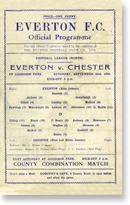 This
summer a series of public events will be held to commemorate
the 60th anniversary of the end of the Second World
War. The proceedings will be held across the country
culminating in National Commemoration Day on Sunday
July 10th. Separate ceremonies will also be held to
mark VE and VJ Days with the VE Day ceremony taking
place on May 8th and the VJ Day ceremony taking place
on Aug 21st. The Football League will also be marking
the occasion by looking at football’s contribution
during the war years. This
summer a series of public events will be held to commemorate
the 60th anniversary of the end of the Second World
War. The proceedings will be held across the country
culminating in National Commemoration Day on Sunday
July 10th. Separate ceremonies will also be held to
mark VE and VJ Days with the VE Day ceremony taking
place on May 8th and the VJ Day ceremony taking place
on Aug 21st. The Football League will also be marking
the occasion by looking at football’s contribution
during the war years.
When war broke out, in September 1939,
Chester had just started their ninth season in the Football
League. Two wins and a draw had put them in fourth place
in Division Three North but normal league football was
suspended following the declaration of war on September
3rd. In October a formal league of 12 clubs was organized
giving Chester the opportunity to compete against clubs
like Liverpool, Everton and the two Manchester clubs.
Chester finished ninth in the first Regional League
(Western Section).
Throughout the war years Chester continued
to compete against the bigger clubs from the area and
achieved some spectacular results. In many cases the
team was augmented by guest players who were stationed
in the area and unable to turn out for their own side.
The difficulties in raising a side also meant that many
local players were given an unexpected opportunity to
represent the club.
 In
the 1942/43 season Chester beat Manchester United twice.
The 4-1 victory in January was watched by only 1500
spectators at Sealand Road and included goals from Jimmy
McIntosh and Harold Iddon who were both on the books
at Preston. The other scorer was Leslie Compton, the
Arsenal full-back, who became the oldest player to make
his England debut in 1950 at the age of 38. Compton
represented Chester on a number of occasions and even
scored a hat-trick for the club when he played at centre
forward in a 5-4 victory against Everton in February
1943. In
the 1942/43 season Chester beat Manchester United twice.
The 4-1 victory in January was watched by only 1500
spectators at Sealand Road and included goals from Jimmy
McIntosh and Harold Iddon who were both on the books
at Preston. The other scorer was Leslie Compton, the
Arsenal full-back, who became the oldest player to make
his England debut in 1950 at the age of 38. Compton
represented Chester on a number of occasions and even
scored a hat-trick for the club when he played at centre
forward in a 5-4 victory against Everton in February
1943.
Many of the wartime games were high
scoring and there could often be a huge turnaround in
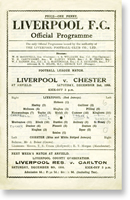
results over a few days. In the 1943/44 season Chester
beat Liverpool 3-1 with two goals from West Bromwich’s
Robin Newsome but sent a weakened team to Anfield the
following week and were hammered 9-0. In the same season
they also lost 3-1 to Manchester United and then beat
them 5-4 a mere seven days later. Other high scoring
game that season included an amazing 9-5 victory over
Crewe, a 9-2 home defeat to Everton and an 8-4 reverse
at Wrexham.
In December 1944 Chester hammered
Manchester City 7-1 with a Scottish forward line including
Armstrong (Aberdeen) and the Hearts pair Andy Black
and Bobby Hamilton. Black, a Scotland international,
was one of the stars of the 1944/45 season and Chester
unsuccessfully tried to sign the popular forward after
the war.
Another famous name to appear in blue
and white was Ellesmere Port born Joe Mercer who had
played more than 150 times for Everton before the war
winning five England caps. When league football resumed
he played for Arsenal and later famously managed Aston
Villa, Manchester City and England. One of the all-time
great centre forwards also played for Chester. Tommy
Lawton of Everton and England played in a friendly against
the RAF and scored 5 goals in an 11-4 victory.
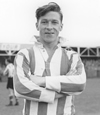 Two
of Chester’s most noted players also made their
full debuts during the war. Local boys Tommy Astbury
(left) and Dick Yates both featured in the opening wartime
fixture against Liverpool. Queensferry born Yates still
holds the City record for most goals in a Football League
season with 36 in 1946/47. Astbury, arguably one of
Chester’s greatest players, went on to play more
than 300 times for the club in peacetime football and
was awarded two Welsh international caps against England
in 1945. He also guested for Manchester United in the
League North Cup Final of 1945 when he finished on the
losing side. Two
of Chester’s most noted players also made their
full debuts during the war. Local boys Tommy Astbury
(left) and Dick Yates both featured in the opening wartime
fixture against Liverpool. Queensferry born Yates still
holds the City record for most goals in a Football League
season with 36 in 1946/47. Astbury, arguably one of
Chester’s greatest players, went on to play more
than 300 times for the club in peacetime football and
was awarded two Welsh international caps against England
in 1945. He also guested for Manchester United in the
League North Cup Final of 1945 when he finished on the
losing side.
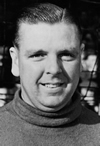 Another
future Welsh international, goalkeeper Bill
Shortt, also launched his football career with Chester
during the war years. Shortt (right), who died last
year, made more than 100 wartime appearances at Sealand
Road but joined Plymouth Argyle for £1000 in January
1946 and went on to play 12 times for Wales. Local youngster
Dave McNeil was a regular at left back during the war
and went on to play more than 100 times for the club
when hostilities ceased. Other players were not so lucky
however. Half-back Reg Dutton appeared frequently in
the side but never played a peacetime league fixture
while Ellesmere Port born Derek Williams played nearly
100 times at centre half but only featured twice in
Division Three North. Another
future Welsh international, goalkeeper Bill
Shortt, also launched his football career with Chester
during the war years. Shortt (right), who died last
year, made more than 100 wartime appearances at Sealand
Road but joined Plymouth Argyle for £1000 in January
1946 and went on to play 12 times for Wales. Local youngster
Dave McNeil was a regular at left back during the war
and went on to play more than 100 times for the club
when hostilities ceased. Other players were not so lucky
however. Half-back Reg Dutton appeared frequently in
the side but never played a peacetime league fixture
while Ellesmere Port born Derek Williams played nearly
100 times at centre half but only featured twice in
Division Three North.
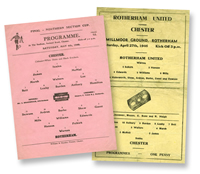 In
the interim season, before the return to regular football,
Chester featured in the two legged final of the Third
Division North Cup Final against Rotherham United. After
a 2-2 draw at Millmoor more than 12,000 spectators turned
up at the Stadium to see if Chester could lift the cup
but they left disappointed as the Millers secured an
aggregate 5-4 win. In
the interim season, before the return to regular football,
Chester featured in the two legged final of the Third
Division North Cup Final against Rotherham United. After
a 2-2 draw at Millmoor more than 12,000 spectators turned
up at the Stadium to see if Chester could lift the cup
but they left disappointed as the Millers secured an
aggregate 5-4 win.
The continuation of football during
the war helped improve the morale of the British public
as they struggled to come to terms with the horrors
of the conflict. Like many clubs Chester had to overcome
transport difficulties and problems in raising a side
but a journey down Sealand Road provided a welcome distraction
from the hostilities. With goals aplenty, First Division
opposition and the chance to see unfamiliar names in
a blue and white shirt Cestrians could at least take
their minds off the war for 90 minutes a week.
Chas
Sumner [Published 30/4/05]
|












 NEW MAN IN CHARGE
 WINNING START
 KING’S LYNN
 Everything you need to know about the club’s history, honours, records and kits. Complete list of fixtures from 1885 and much more.